
The last week of March was characterized by a significant intensification of intra-regional diplomacy and proactive security management across Central Asia. In a landmark diplomatic event, the presidents of Uzbekistan and Tajikistan inaugurated a new embassy in Tashkent and toured historic sites in Bukhara, signaling a definitive shift toward a "neighborhood first" policy. This regional cohesion was mirrored in the Eurasian Intergovernmental Council, where member states debated new mechanisms to protect smaller economies, and within the CSTO, which launched the "Illegal-2026" operation to secure regional borders. Kazakhstan continued to demonstrate the efficacy of its "multi-vector" diplomacy, balancing billion-dollar industrial projects with Russia and green energy partnerships with China, while positioning itself as a neutral mediator by offering Turkestan as a venue for Middle East peace talks. On the economic and digital fronts, Uzbekistan secured a massive $1.42 billion investment portfolio for 2026 and cleared regulatory hurdles for global payment systems, while Kyrgyzstan accelerated its transition into a regional logistics hub with plans for 40 new trade centers. Simultaneously, the region addressed long-term sustainability, with Kazakhstan launching new hydroelectric projects and engaging Russia in urgent high-level talks to address the ecological crisis of the Caspian Sea.
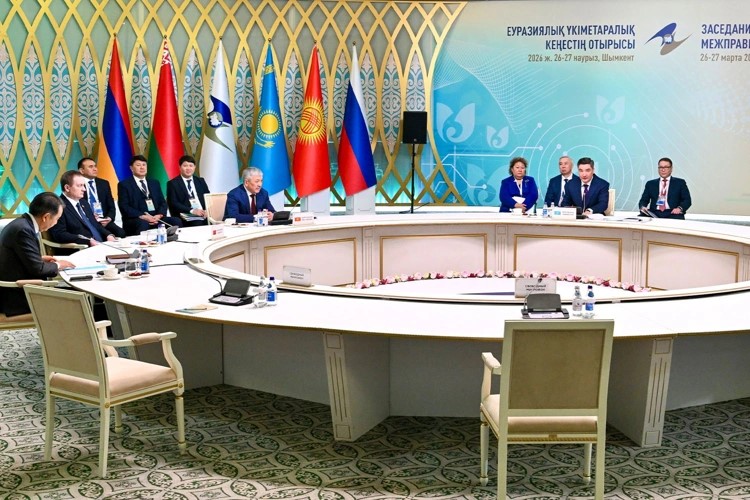
EAEU heads of government convene in Shymkent. Source: Kaz Inform
Diplomatic Events
The Eurasian Intergovernmental Council convened in Yerevan, bringing together heads of government to address deepening economic integration and collective security within the Eurasian Economic Union (EAEU). Kyrgyzstan's Cabinet Chairman, Akylbek Japarov, actively participated in the high-level meeting, which concluded with the signing of several strategic documents aimed at harmonizing customs regulations and digital trade standards across the bloc (Kabar). These agreements are designed to streamline the movement of goods and services, reinforcing the Union’s internal market against external economic pressures.
During the summit, the Kyrgyz Republic took a proactive stance on protecting the interests of smaller member states. Cabinet Deputy Chairman Adylbek Kasymaliev proposed the adoption of an "industrial reservation" principle, which would allow smaller EAEU economies to develop specific industrial sectors without facing overwhelming competition from larger members (AKIpress). This proposal seeks to ensure more equitable industrial development and prevent the marginalization of emerging manufacturing bases within the bloc. Simultaneously, Kazakhstan utilized the platform to outline its priorities for its EAEU chairmanship, emphasizing the expansion of external trade partnerships and the modernization of the Union’s transport corridors to better connect with global markets (Kabar). These diplomatic maneuvers highlight the ongoing efforts within the EAEU to balance national economic protectionism with the broader goals of regional integration.
Elsewhere, the diplomatic relationship between Uzbekistan and Tajikistan reached a new milestone as President Shavkat Mirziyoyev and President Emomali Rahmon officially inaugurated the new building of the Tajikistan Embassy in Tashkent (UzDaily). This high-profile opening serves as a symbol of the "comprehensive strategic partnership" and "eternal friendship" between the two nations, which have seen a rapid warming of ties over the last several years. The ceremony was a central component of President Rahmon’s multi-day state visit, designed to institutionalize diplomatic cooperation and facilitate more efficient bilateral communication across all levels of government.
During the visit, the two leaders traveled to the city of Bukhara, where they toured several historic and religious landmarks, including the Po-i-Kalyan complex and the Ark of Bukhara (Daryo). This cultural engagement was framed as a celebration of the shared heritage and civilizational links that bind the Tajik and Uzbek peoples together. President Rahmon concluded his state visit following a series of high-level negotiations focused on expanding trade turnover, water-energy cooperation, and regional security (UzDaily). The visit underscores a broader trend of Central Asian states prioritizing intra-regional diplomacy and "neighborhood first" policies to build resilience against external geopolitical volatility.
Back in Kazakhstan, the multi-vector foreign policy was on full display this week as President Tokayev engaged with key regional and global powers to advance the nation’s strategic and economic interests. In a high-level meeting with Russian Foreign Minister Sergey Lavrov, Tokayev discussed the implementation of several joint industrial projects worth billions of dollars and confirmed the schedule for President Vladimir Putin’s upcoming state visit to Kazakhstan in May (Tengri News). This engagement reinforces the deep economic and security ties between Astana and Moscow even as Kazakhstan pursues broader international partnerships.
Simultaneously, Kazakhstan intensified its engagement with China and the Turkic world. At the Boao Forum for Asia, Kazakhstani representatives held talks with Chinese officials to deepen cooperation in green energy, transport logistics, and high-tech manufacturing, further integrating Kazakhstan into the "One Belt, One Road" initiative (Orda). Meanwhile, President Tokayev held a phone conversation with Turkish President Recep Tayyip Erdoğan to exchange holiday greetings and coordinate on the upcoming Organization of Turkic States (OTS) summit, which is scheduled to take place in mid-May in the historic city of Turkestan (Orda, Kabar). These synchronized diplomatic efforts illustrate Astana's strategy of balancing relations between major global actors while positioning itself as a central hub for Eurasian transit and Turkic integration.
In the meantime, the intensifying conflict in the Middle East has prompted a series of high-level diplomatic interventions from Central Asian leadership and security blocs. Kazakhstan has officially signaled its readiness to serve as a neutral mediator, offering the city of Turkestan as a venue for potential peace talks between Iran and its regional adversaries (Tengri News). This proposal was further discussed during a telephonic consultation between the Foreign Ministers of Kazakhstan and Iran, where both parties reviewed the deteriorating security situation and underscored the need for de-escalation to prevent a wider regional conflagration (QazInform). By offering a platform for dialogue, Astana seeks to leverage its reputation as a global mediator to insulate the Eurasian continent from the fallout of the crisis.
In parallel, the Collective Security Treaty Organization (CSTO) issued a formal statement expressing grave concern over the military escalations surrounding Iran. The bloc emphasized that the use of force in the region threatens to undermine the existing international security architecture and called on all involved parties to exercise maximum restraint (Tengri News). The CSTO's involvement highlights the collective anxiety shared by member states—including Kazakhstan, Kyrgyzstan, and Tajikistan—regarding the potential for the conflict to disrupt trans-regional trade routes and impact the broader security perimeter of Central Asia. These diplomatic and institutional responses underscore the region's proactive shift toward crisis management as the Middle East remains a volatile variable in Eurasian stability.
Macroeconomics
Uzbekistan’s economic trajectory remains a focal point for international financial institutions as the country navigates its "Twin Transition." High-level consultations with the International Monetary Fund (IMF) focused on the implementation of comprehensive measures to maintain macroeconomic stability amidst global market volatility (UzDaily). The discussions centered on refining fiscal and monetary policies to curb inflation while ensuring sustainable growth. In parallel, the Asian Development Bank (ADB) and the Uzbek government reviewed a massive portfolio of investment projects slated for 2026, totaling $1.42 billion (UzDaily). These projects are expected to target critical infrastructure, energy efficiency, and private sector development, reinforcing Uzbekistan's status as a primary destination for development capital in Central Asia.
Connectivity
The strategic development of rail infrastructure took center stage in Bishkek, where representatives from Shanghai Cooperation Organization (SCO) member states gathered to discuss deepening cooperation in the railway sector (Kabar). The meeting focused on harmonizing technical standards and digitalizing transit procedures to accelerate cargo flow along the burgeoning "China-Central Asia-Europe" corridors. Complementing these international rail initiatives, the Kyrgyz Republic announced an ambitious domestic infrastructure plan to build 40 new trade and logistics centers by 2030 (Kabar). By positioning itself as a regional transit hub, Kyrgyzstan aims to integrate its domestic agricultural and industrial output more effectively into these expanding international rail networks.
In Kazakhstan, urban connectivity reached a technical milestone as testing continued on the Astana LRT (Light Rail Transit) system. During the latest trial phase, trains successfully accelerated to 80 kilometers per hour, a critical benchmark for the project’s operational feasibility (Orda). This development is a key component of the "New Kazakhstan" urban modernization strategy, intended to alleviate traffic congestion in the capital and provide a high-tech model for public transport that aligns with the country’s broader digital and green transition goals.
Digital Transformation
Uzbekistan’s digital evolution is set to reach new frontiers with the official announcement that the country will begin testing satellite internet services in 2026 (Daryo). This initiative aims to bridge the digital divide in remote and mountainous regions, ensuring that the benefits of the national "Digital Uzbekistan — 2030" strategy extend beyond urban centers. To support this expanding digital ecosystem, the government has launched new international digital and financial hubs, designed to attract global fintech companies and tech entrepreneurs by offering specialized infrastructure and a favorable regulatory environment (UzDaily). These hubs are intended to position Tashkent as a leading regional center for innovation and digital services in Central Asia.
In a move to further integrate into the global digital economy, Uzbekistan has officially updated its regulatory framework to allow the offshore storage of personal data for international payment systems such as PayPal and Apple Pay (UzDaily). This critical reform removes previous legal barriers that restricted the operation of global financial platforms within the country. By aligning its data protection laws with international commercial standards, Uzbekistan is facilitating easier access to global marketplaces for its citizens and businesses, while signaling a pragmatic approach to digital governance and cross-border financial cooperation.
Green Transition
Kazakhstan is significantly expanding its renewable energy portfolio with the announcement that three new hydroelectric power plants will be constructed to bolster the national grid (Orda). This initiative is a key pillar of the country's strategy to diversify its energy mix and reduce its long-term dependence on coal-fired generation. Beyond infrastructure, the government continues to promote environmental awareness through symbolic national actions, such as the country-wide participation in Earth Hour, where major cities across Kazakhstan turned off non-essential lighting to signal commitment to global climate goals (Orda).
Environmental cooperation also took center stage during high-level bilateral talks in Astana between Kazakh Prime Minister Olzhas Bektenov and Russian Prime Minister Mikhail Mishustin. The discussions focused on the deteriorating ecological state of the Caspian Sea, specifically addressing declining water levels and the protection of marine biodiversity (Orda). Both sides reviewed the progress of joint environmental projects worth billions of dollars, emphasizing that the preservation of the Caspian is a shared strategic priority that requires coordinated transboundary management to ensure the sustainable development of the region's coastal economies.
Defense and Security
The Collective Security Treaty Organization (CSTO) has initiated a high-level coordination effort to manage the logistics for the upcoming regional operation, "Illegal-2026" (AKIpress). This operation is a centerpiece of the bloc’s collective security strategy, focusing on the suppression of illegal migration channels, the dismantling of transnational criminal networks, and the tightening of border controls across member states. The coordinated planning emphasizes the use of integrated intelligence-sharing and rapid-response logistics to secure the organization's perimeter against unconventional security threats.
In Kyrgyzstan, President Sadyr Japarov chaired a strategic session of the Security Council to address the volatile situation in the Middle East and its potential impact on national and regional stability (AKIpress). The council’s deliberations focused on mitigating external shocks to the Kyrgyz economy and social fabric, with a particular emphasis on monitoring extremist influences and ensuring the protection of the state's sovereignty. President Japarov underscored that while the Republic remains committed to international diplomatic efforts, the immediate priority is a proactive defense of the domestic constitutional order against any spillover from regional conflicts.