
The first week of December 2025 served as a bridge between a record-breaking year of regional growth and a looming 2026 defined by austerity and energy constraints. While economic forecasts from the Eurasian Development Bank (EDB) projected a robust finish for the year—particularly for Kyrgyzstan and Tajikistan—the internal narrative in Uzbekistan and Kazakhstan shifted toward emergency readiness. In Tashkent, the government launched a massive infrastructure drive to prevent a winter grid collapse, while in Astana, the focus turned to a cooling business climate and the challenges of meeting OPEC+ oil quotas. This week confirmed that the "low-hanging fruit" of post-pandemic recovery has been picked, and the region is now entering a phase where structural resilience will be the only currency that matters.
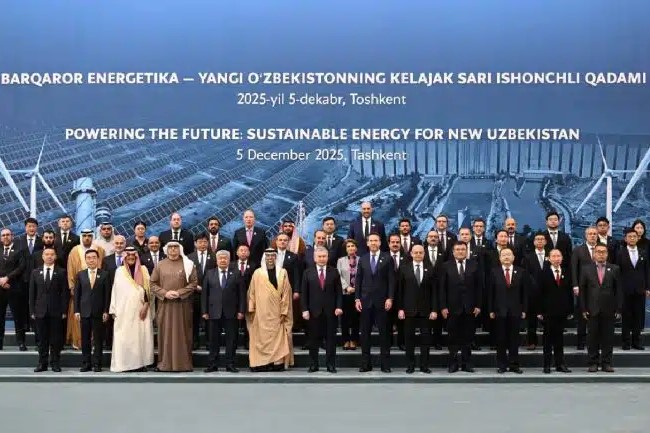
"Powering the Future" forum was held in Tashkent. Source: Kursiv
Diplomacy and Connectivity
The week’s primary connectivity headline was the breakthrough in financing for the China-Kyrgyzstan-Uzbekistan (CKU) railway. On December 5, 2025, it was confirmed that a syndicate of Chinese banks, including the China Development Bank and EximBank, finalized a $2.3 billion preferential loan with a 35-year term. This agreement cleared the final financial obstacle for the "most difficult railway in Central Asia," which will involve 50 bridges and 29 tunnels across the Pamir Plateau. Kyrgyz Deputy Prime Minister Bakyt Torobaev emphasized that this project is no longer a "grand blueprint" but a realistic roadbed that will shorten the route to Europe by 900 kilometers (Seetao.com; RailwayPro). Simultaneously, diplomatic circles in Almaty and Tashkent finalized the "Tokyo Initiative" ahead of the mid-December Japan summit, focusing on a 3 trillion yen package for digital governance and quality infrastructure (AA.com.tr).
Economic Policy, Trade, and Finance
In Kazakhstan, the National Bank released data on December 7 showing a "dip" in the Business Climate Index, which fell to 5.3 from 9.9 in November. While manufacturing remained in the growth zone, the services and construction sectors reported a sharp decline in demand (Trend.az). Kazakh entrepreneurs cited the tax burden and limited access to finance as their primary 2026 anxieties (NationalBank.kz). Conversely, the EDB’s year-end reports highlighted Uzbekistan as the "largest beneficiary of mutual investments" in Eurasia, projecting 7.4% GDP growth for 2025. However, analysts warned that this growth would likely moderate to 6.8% in 2026 as consumer activity cools following a year of intense structural reforms (Upl.uz).
Climate Change and Environmental Sustainability
Environmental security became a matter of immediate grid survival this week. In Tashkent, President Shavkat Mirziyoyev hosted the "Powering the Future" forum on December 8, but the lead-up to the event was dominated by emergency measures. Uzbekistan broke ground on 21 new energy projects worth $11 billion, aimed at boosting renewable output to 23 billion kWh by 2026 (Kursiv.media). This rush for renewables is driven by a deficit that became visible this week; officials reported that an accident in a neighboring country’s gas network cut Uzbekistan’s daily intake by 6 million cubic meters, forcing temporary evening rationing to stabilize the grid during peak hours (Timesca.com).
Security and Defense Cooperation
In Tajikistan, the week was defined by a significant expansion of the Anti-Corruption Law. On December 5, 2025, President Emomali Rahmon signed amendments requiring a much broader list of officials—including those in foreign missions and state-run banks—to declare their assets. For the first time, these declarations must include everything from gemstones to livestock both in Tajikistan and abroad (Timesca.com; Asia-Plus). In Kazakhstan, security news focused on energy sovereignty; the government confirmed it is exceeding its OPEC+ quotas (producing 1.68 million bbl/d vs. the 1.53 million bbl/d quota) while simultaneously negotiating a reduction in these quotas to 1.0 million bbl/d by March 2026 to manage domestic demand (AERC.org.kz).
Digital Transformation and Infrastructure
Digitalization has moved from administrative convenience to a tool for "shadow economy" suppression. This week, Kyrgyzstan launched the "Salyk Kuzot" digital tax monitoring system, aimed at integrating all retail transactions into a national database by 2026 (24.kg). In Uzbekistan, the digitalization of the gas sector reached a milestone with the pilot of Face-ID technology for gas filling stations in the Andijan region, a move designed to prevent the siphoning of subsidized gas that has historically plagued the winter months (UzDaily.uz).