
The final week of November 2025 was defined by the transition into "winter diplomacy," where the region's energy interdependencies were formally codified to prevent a repeat of previous blackouts. A landmark trilateral energy protocol between Kazakhstan, Uzbekistan, and Kyrgyzstan served as the week's strategic anchor, trading electricity for water security in 2026. This period also saw Kazakhstan take a global lead in digital ethics with the signing of the first comprehensive Law on Artificial Intelligence in the region. Politically, the week was bookended by high-level state visits and the conclusion of Kyrgyzstan's parliamentary elections, signaling a push for institutional stability before the year-end holidays.
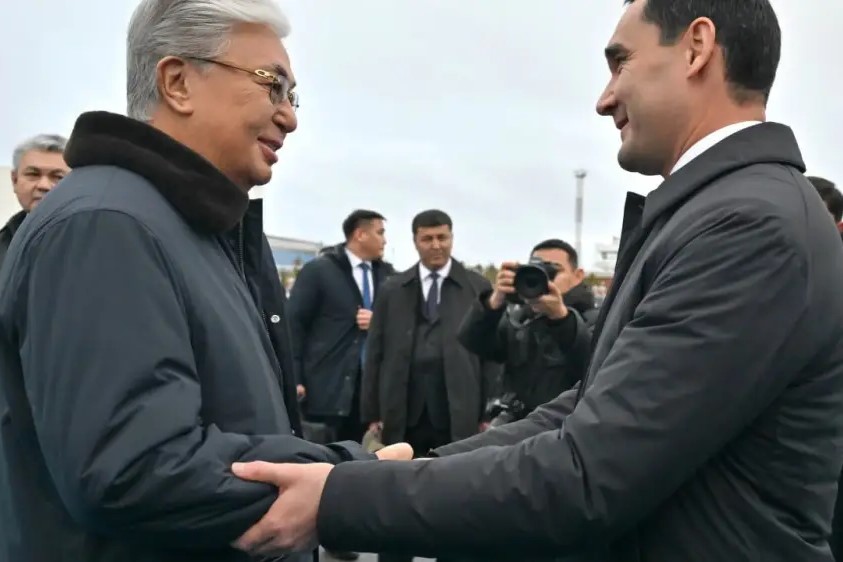
President Tokayev welcomed Turkmenistan’s leader Serdar Berdimuhamedov upon his arrival in Astana for a state visit. Source: Tengri News
Diplomacy and Connectivity
The primary diplomatic event of the week was the state visit of Turkmen President Serdar Berdimuhamedov to Astana on November 24–25. President Tokayev personally welcomed the Turkmen leader, emphasizing a "strategic partnership" focused on gas transit and the Caspian transport nodes. The talks resulted in agreements to streamline the North-South transport corridor, positioning the Turkmenistan-Kazakhstan border as a critical transit point for Afghan and South Asian trade (Tengrinews.kz). Additionally, on November 24, Chinese Foreign Minister Wang Yi concluded a regional tour in Tashkent, where he and President Mirziyoyev finalized the "visible cooperation results" for the China-Kyrgyzstan-Uzbekistan (CKU) railway, pushing for a trade volume of $20 billion by the end of the 2026 fiscal year (MFA China).
Economic Policy, Trade, and Finance
The economic narrative was dominated by "resource-swap" agreements. On November 23–24, authorities from Kazakhstan, Uzbekistan, and Kyrgyzstan signed a trilateral protocol defining winter electricity supplies. In a sophisticated barter, Kazakhstan and Uzbekistan agreed to supply electricity to the Kyrgyz Republic through the winter. This allows Kyrgyzstan to conserve water in the Toktogul reservoir, which will then be released in the summer of 2026 to irrigate agricultural lands in Kazakhstan and Uzbekistan (The Astana Times). Meanwhile, Uzbekistan reported a surge in foreign trade turnover, reaching $44.4 billion for the first seven months of the year, with Russia and China anchoring the growth as the country prepares for a WTO accession push in early 2026 (Daryo.uz).
Climate Change and Environmental Sustainability
Environmental policy focused on mitigating the "challenging hydrological situation" at regional reservoirs. The trilateral energy-water swap mentioned above is the region’s primary defense against climate-induced water scarcity. Beyond water, the week saw a regional focus on green trade; a CAREC ministerial workshop in Seoul (Nov 25–27) specifically addressed "Digital and Green Trade Facilitation," aiming to harmonize environmental standards for Central Asian exports (CAREC Program). In Uzbekistan, the Ministry of Energy confirmed that renewable energy plants are now being integrated with "Face-ID" digital monitoring to prevent resource theft during the high-demand winter months.
Digital Transformation and Infrastructure
Kazakhstan achieved a regional first on November 17 (with detailed regulatory rollout during the week of Nov 24) with the signing of the Law on Artificial Intelligence. The law, which takes full effect in January 2026, establishes a "National AI Platform" and introduces a direct ban on social scoring and manipulative subconscious techniques. It mandates that any synthetic content (images/text/video) must be machine-readable and clearly labeled, setting a strict transparency standard for the tech sector (EY.com). In Uzbekistan, the government announced the centralization of all research infrastructure through an AI-based platform to streamline scientific development and bridge the gap between academia and industrial application.
Security and Defense Cooperation
Regional security focused on border stability and electoral integrity. Kyrgyzstan held its snap parliamentary elections on November 30, a process monitored closely for its impact on regional political stability. Just prior to this, on November 16–17, the foreign ministers of Kyrgyzstan, Tajikistan, and Uzbekistan formally exchanged ratification instruments for the treaty on the junction point of their borders, legally fixing the exact intersection of the three nations for the first time in history (Security Council Report; Kabar.kg). While the border was legally clarified, the GBAO region in Tajikistan remained under a high security presence following cross-border incidents from Afghanistan, highlighting the persistent "Southern Frontier" risk (Gov.uk).